Monster: The Lizzie Borden Story (2026): Is It Worth Watching, and How Accurate Is It? | BLAKWATCH Review


Netflix got me with this one. The preview looked good, the performances pulled me in, and the whole thing was gorgeous. I finished Monster: The Lizzie Borden Story wanting to like it.
Then I checked the history.
That is where this relationship started having problems.
So, is it worth watching? There is plenty to enjoy. How accurate is it? There is plenty to question. And those two answers are very much connected to my 5/10.
Writer + Director + Studio
Writer: Ian Brennan, co-creator of Glee and the Monster anthology.
Directors: Max Winkler (Flower, Jungleland) and Sarah Adina Smith (Buster’s Mal Heart, Birds of Paradise). Winkler directed six of the eight episodes.
Creators and executive producers: Ryan Murphy and Ian Brennan, with the wider production team.
Production: Ryan Murphy Television, for Netflix.
Released: September 17, 2026.
Format: Eight episodes; season four of Monster, following Dahmer, the Menendez brothers, and Ed Gein.
This is a Ryan Murphy production, but I want to give the people doing the actual writing, directing, and design their credit. “Ryan Murphy’s camp” is how I think of it. A very recognizable camp, as it turns out.
Starring: The Lizzie Borden Netflix Cast
Ella Beatty (Feud: Capote vs. the Swans) as Lizzie Borden.
Vicky Krieps (Phantom Thread, Corsage) as Bridget “Maggie” Sullivan and Elizabeth Báthory.
Sarah Paulson (American Horror Story, The People v. O. J. Simpson) as Aileen Wuornos.
Rebecca Hall (The Town, The Night House) as Abby Borden.
Charlie Hunnam (Sons of Anarchy, The Lost City of Z) as Andrew Borden.
Billie Lourd (American Horror Story, Booksmart) as Emma Borden.
Jessica Barden (Holler, Hanna) as Nance O’Neil.
Intro / Opener: Netflix Got My Attention
I like Ryan Murphy. Sometimes I want to like Ryan Murphy more than Ryan Murphy lets me.
His productions know how to pull you into a world. The styling, the atmosphere, the talent—there is usually something that makes me want to see what his team is doing. Then somewhere along the way, a decision gets made, and I start asking questions.
I enjoyed Dahmer a lot. I also enjoyed The Ed Gein Story. I have not watched the Menendez season yet, so my review of the entire anthology will have to wait.
For this one, the Netflix preview did its job. I thought I could put the show on while doing other things.
No. Apparently we were watching this with our full attention.
The silence, the close-ups, the emotional intensity, and Bridget’s whole presence pulled me in. There was something intriguing about her almost immediately. The opening violence grabbed me, too. I came back the next day to finish.
I knew Lizzie Borden’s name. I did not know enough about her case to recognize what the show was inventing. So after watching, before settling on a score, I went looking.
I wish the history had made me like it more.
First Impression (Spoiler-Free): Is The Lizzie Borden Story Worth Watching?
If you love period pieces and strong acting, yes, there is something here for you. This show is beautiful. The costumes, the interiors, the color palette, and the atmosphere deserve their praise.
The performances deserve even more.
Expect a slow burn with sudden bursts of intensity. It has that measured, old-world rhythm I enjoy, until something violent or emotionally explosive cuts through it. It held my attention.
But it also wanders between stories, and those interruptions will test you if you prefer a focused narrative. There is graphic violence and sexual assault. This is not a casual watch just because everyone is dressed beautifully.
It never gave me the sustained dread of Dahmer. That season had the awful tension of watching someone move through the world while his potential victims had no idea who they were dealing with. Here, the appeal leans more toward forbidden romance, rebellion, and cruel people getting their comeuppance.
Which can be satisfying.
Until you start wondering whether those real people were actually cruel.
My BLAKWATCH score: 5/10. I enjoyed the experience more than I trusted the story.
Spoiler Section
From here forward, we are talking about the murders, relationships, trial, and ending.
Story: How Good Is The Lizzie Borden Story?
Taken as fiction, a lot of this works.
Lizzie and Bridget’s relationship is interesting. Their secrecy, their intimacy, and the possibility of finding freedom together give the household drama something worth following. The dialogue has this odd, old-fashioned bite to it. People say things in ways that are quirky, funny, and occasionally wonderfully strange.
Then there is Abby.
They gave this woman the full evil-stepmother package. Rebecca Hall plays her so well that I enjoyed watching her be terrible. She has that Mommie Dearest energy: the cruelty is so heightened it starts becoming funny. I was half expecting a white glove inspection.
As a fictional villain? Entertaining.
As a portrayal of a real murder victim? Now we have a problem.
The series made me root for these people to die. That is a serious choice when you are inventing the behavior that makes their deaths feel deserved. We are not filling in an unknown dinner conversation anymore. We are supplying the reason an audience cheers for a murder.
Bridget’s introduction also had me intrigued, although she starts out a little too capable. She can clean the blood, handle the situation, guide Lizzie, and apparently run the entire operation. Everyone else is having a crisis; Bridget has already organized the crisis.
That is where the Mary Sue feeling comes in for me. I liked her becoming more complicated and human. I wanted some of that complexity from the beginning.
Lizzie initially looked so young to me that the romance threw me off. I thought I was watching a much younger girl. Historically, she was 32 when the Borden murders happened. Beatty is well cast, but the look and characterization took a while to communicate that age to me.
The pacing itself mostly worked. I liked the slow rhythm. What I did not like was getting pulled away from the story once I was invested.
It reminded me of Naruto: we are in the middle of an enormous fight, fists are flying, and suddenly we have several episodes of somebody’s childhood flashback to attend to. I understand the value of a flashback. Can we finish throwing these particular fists first?
That was the feeling when Wuornos arrived.
Sarah Paulson is outstanding. I still wanted to get back to Lizzie.
The invented visit to the Borden house, complete with a conversation with Lizzie’s ghost, was especially frustrating. This season felt more like American Horror Story than the other Monster seasons I have seen. I enjoy plenty of AHS (even when it's bad). But the crossover here feels like the writers could not resist bringing their favorite party trick into another room.
Lizzie’s fictional story already had enough going on. Why interrupt it to force this connection?
I would have preferred a season centered on Wuornos. There are established killings, convictions, testimony, and footage of the actual woman. There is a foundation there. Paulson’s performance made me want to see what a full season could do with it.
The trial episode was one of the strongest, possibly the best. It had spectacle, momentum, and performances that made the courtroom exciting. Nance coaching Lizzie is good drama, even though that part of the history does not hold up.
Then the finale keeps going after what felt like the actual climax.
I wanted to see what happened afterward. I did not need the ending to start another shift. The trial gets its own episode, which I understand, but the aftermath could have been tighter. By the end, I felt the show had already made its strongest exit and then come back to tell me a few more things.
How Accurate Is Netflix’s The Lizzie Borden Story? Fact vs. Fiction
The names and central murder case are real. Much of the explanation built around them is invented. Some choices fill historical gaps. Others contradict information that is already available.
That second category bothers me much more.
Here are the differences that most affected my review:
In the Netflix series | In the historical record |
Lizzie commits the Borden murders. | Andrew and Abby were killed on August 4, 1892. Lizzie was acquitted in June 1893. The murders remain unsolved. |
Lizzie and Bridget have a romance and plot the killings together. | There is no reliable evidence establishing that relationship or joint murder plan. |
Andrew and Abby’s abuse explains Lizzie’s revenge. | Household tensions existed, but the specific cruelty used to justify the killings is not established. |
Lizzie kills an older, abusive Bertha Manchester before the Borden murders. | Manchester was 22 (not an old lady) and was murdered in May 1893, while Lizzie was jailed. José Correa de Mello was convicted. |
Nance O’Neil coaches Lizzie before the trial. | Their documented friendship began afterward; accounts place their meeting in 1904. |
Wuornos visits the Borden house as a bed and breakfast. | Wuornos was arrested in January 1991. The bed and breakfast opened in 1996, while she was imprisoned. |
Báthory bathes in blood. | Blood bathing is a later legend, rather than an established historical account. |
The National Women’s History Museum covers the Borden case. Reporting on Manchester, Nance O’Neil, Wuornos, and Báthory explains those separate histories.
Bertha Manchester is the clearest example of going too far. A real young woman was murdered. The show turns her into an older abuser, moves the crime, and gives it to Lizzie.
Lizzie was in jail when it happened.
Another person was convicted of her murder.
At that point, what exactly are we adapting?
There is already plenty of uncertainty in this case. Why contradict the things we do know? Especially when the contradiction involves making a real victim unpleasant enough that we welcome her death.
Did Lizzie Borden Actually Do It? Could She Have Been Innocent?
Her guilt has never been conclusively established. She was acquitted, and the murders remain unresolved. Yes, it is possible she was innocent.
The show picks its answer and builds a motive around it.
That is why I do not think Lizzie was the right central subject for this Monster season. An anthology tells different principal stories under the same series name. The earlier subjects were established killers, though they were not all serial killers.
Lizzie brings an unresolved question into that company. Instead of working with the uncertainty, the show gets very comfortable answering it.
The mystery is part of what makes her interesting. It is also what should make a writer think carefully before giving her a complete murder résumé.
How Many People Did Lizzie Borden Kill?
There is no confirmed number of killings attributable to Lizzie Borden. She was accused of murdering two people, Andrew and Abby Borden, and acquitted of both murders.
The show gives her those killings and adds Manchester.
That third killing is especially hard to defend because Manchester’s documented murder happened while Lizzie was in custody. This is not just an unresolved question receiving a dramatic answer. It is a separate crime being reassigned.
How Much Time Did Lizzie Borden Get?
She received no prison sentence for the Borden murders. She was acquitted on June 20, 1893.
She did spend about ten months in custody awaiting trial, from August 1892 to June 1893.
Her acquittal surprised me while watching. I expected a conviction, which tells you something about how little of the real case I knew going in—and how confidently the series had sold me its version.
What Evidence Did They Have Against Lizzie Borden?
The case was largely circumstantial. Suspicion involved her presence at the house, her accounts of her movements, household friction, and testimony that she burned a dress after the murders.
She said the dress had paint on it. Burning it looked suspicious, but that did not establish that it was bloodstained. Her inquest testimony was excluded from the trial, and a murder weapon was never conclusively linked to her. This account of the evidence explains the case and the trial rulings.
There were reasons to suspect her. There were also reasons the prosecution did not get its conviction.
The show has the luxury of writing the missing pieces. The jury did not.
Why Is Lizzie Borden So Famous?
A brutal double murder, a sensational public trial, an acquittal, and a question that never went away: did she do it?
Then the nursery rhyme kept her name circulating long after the trial.
The rhyme also exaggerates the blows. The familiar forty and forty-one do not match the documented injuries, generally described as about eleven blows to Andrew and nineteen to Abby.
That is part of the problem with adapting Lizzie. The legend is loud. The evidence is less obliging. This series seems much more comfortable with the legend.
Visuals: Beautiful, Even When I’m Asking Questions
Visually, this show delivered.
The wardrobe is excellent. The wealthy characters have the rich fabrics and opulence you expect, but the servants and less affluent people look thoughtfully dressed too. It is not enough to put everyone in something old and announce that we have arrived in history.
The deep navy and black, the creams and tans, the blues and pinks—I loved that palette. The contrast gives the images a richness that kept catching my eye.
Costume designer Paula Bradley and production designer Matthew Flood Ferguson deserve recognition here, along with the directors and camera teams. The crew credits help put names to that work.
The close-ups are especially effective. We spend time right in people’s faces, where a small change in expression can do the work of an entire speech. Women looking at each other, talking privately, or responding to something painful feel intimate and emotionally immediate.
This is where the show’s focus on women feels natural to me. The camera cares about their inner lives. It does not need to keep announcing the theme.
The imagery has plenty going on, too. Blood becomes something to clean away, hide, bathe in, or use as a kind of release. Cherries bring in desire, blood, and forbidden fruit. The garden gives Lizzie and Bridget a place outside the household’s rules.
That cherry bath looked beautiful, but somebody explain the produce budget. How many cherries did these women go through? I’m supposed to be watching forbidden romance, and now I’m mentally operating a juice factory.
The steaming blood bath had me asking questions too. They wanted that image badly. You can practically feel the room deciding that the Bloody Countess absolutely must have her blood bath.
The Countess and her attendants look striking, but the further back we go, the closer we get to Dracula’s wardrobe department.
Then there are the birds. Cages make confinement visible, and the slaughter turns freedom into something fragile that can be destroyed. It is effective imagery.
Historically, Lizzie discussed Andrew killing pigeons. The show gives the bird killing to Abby. Of course it does. Apparently the evil-stepmother package needed one more feature.
The visual storytelling is often excellent. Sometimes it is so good that I have to remind myself to question the story underneath it.

Performances: Nobody Here Owes Me an Apology
The performances are the highlight. I have no complaints.
These people can act. They can cry, express complicated emotions, and let us see several things happening inside a character at once. The direction gives them room to do it.
Ella Beatty is excellent as Lizzie. Her scenes with Nance, learning how to sit, glance, speak, and perform innocence, are especially good. She has to convincingly play someone who is not yet convincing. Then we watch her learn.
That takes control. It is easy to overlook because she makes it look so natural.
Vicky Krieps is outstanding as Bridget. Her presence was one of the things that made me want to keep watching. Then she becomes Báthory and gives us a completely different energy.
Jessica Barden makes Nance entertaining, and Rebecca Hall commits to every inch of Abby’s villainy. I loved Hall’s performance. My objection is to what the writers have made this real woman into.
Sarah Paulson, though.

Her Wuornos performance was masterful. I already knew what Paulson could do beacuse of work on AHS, and she still impressed me. It goes far beyond the makeup. The movement, the expressions, the emotion—there is a person in there. Poulson literally became this woman.
I understand the criticism that the portrayal can feel a little caricatured. I do not think that belongs entirely on Paulson.
Wuornos herself had distinctive speech and mannerisms. Playing those qualities can look exaggerated. Then the writing gives her funny, rough, defiant lines inside a production that already has a soapy, heightened tone. The actor does not control all of that.

It reminded me of Freeway, with Reese Witherspoon and Kiefer Sutherland: danger, sexual violence, dark humor, and a woman fighting back in this exaggerated world. The tone kept bringing that movie to mind.
But watch Paulson in prison, especially as Wuornos faces execution. I do not see camp there. I see fear. I see emotion. I see someone facing death.
Those scenes are part of why I wanted her to have a whole season. Give us more of her life. Give us ordinary moments and contradictions. Let the performance breathe instead of requiring it to explain a new person late in someone else’s story.
It is a little like the Mandalorian showing up in The Book of Boba Fett and making you reconsider whose show you wanted to watch. Except here I still wanted to return to Lizzie. Paulson elevated the material; the detour interrupted it.
If I absolutely had to pick a least favorite performance, it would be Hunnam’s Andrew. And I am glad nobody is making me pick, because he is good too.
The casting department did its job.
Themes: Freedom, Confinement, and the Slaughter of Innocence
The show is deeply interested in women being told how to live.
Marry this kind of man. Behave this way. Hide that desire. Know your place. Be quiet about what has happened to you.
Confinement runs through everything: the birds in cages, the household, the rules around sexuality, the treatment of servants, and the actual imprisonment of these women.
Even when Lizzie has wealth and more control over her life, she does not seem free in the way she wanted. She ends up isolated, surrounded by animals, in another prison—this time with a better budget.
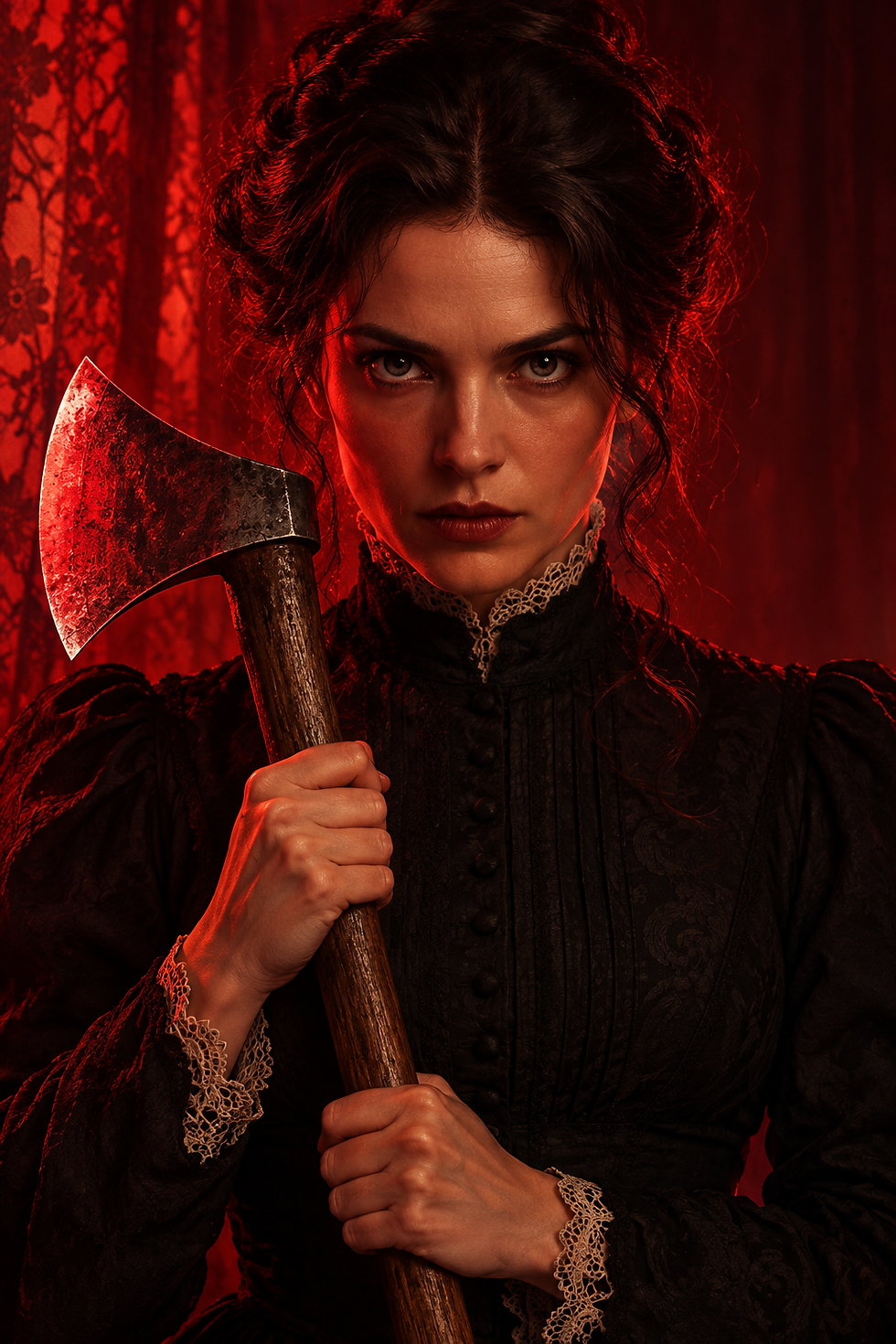
Class and prejudice are woven in too. The repeated suspicion of “the Portuguese” shows how quickly people reach for an outsider to blame. Money gives certain people authority, while Bridget’s position makes her someone others feel entitled to control.
The slaughter of innocence is another major thread: the Countess’s baby, Lizzie’s birds, and the sexual violence Wuornos describes. Something precious gets destroyed, and something inside these women breaks with it.
Even the axes fit. Lives, relationships, and identities are being split apart. Violence becomes the means of cutting away from a world that will not let them go.
Blood carries several meanings: shame, concealment, beauty, release, and almost baptism. The garden and forbidden fruit bring Eve to mind, along with the old language of women’s bodies and menstruation as a “curse.” There is an effort to take those images and make them belong to the women themselves.
There is a lot to work with.
But I do not think the three-woman connection holds together.
Lizzie, as written here, is retaliating against her household. Two of the three people the show has her kill are women. Báthory’s cruelty does not suddenly become sympathetic because we are shown a traumatic origin. Wuornos’s experiences and crimes present another set of questions entirely.
Wuornos described serious sexual violence, and her suffering matters. Being a sex worker does not make someone available for assault. Her accounts of the killings also changed, and her self-defense argument was rejected. The court record is more complicated than a straightforward revenge story.
And Báthory’s blood baths are later legend. Her history contains disputed accusations and contested explanations, which the show turns into confident imagery.
I understand the argument about female rage. I just do not think putting these women next to each other does all the work the writers seem to think it does.
Then the suffrage material arrives near the end, and it feels like the show is trying to pin a larger victory onto the story.
I was not convinced. The connection needed more than a strong closing statement.
Hits & Misses
Hits — On Point
The performances. The biggest success, without question. Beatty, Krieps, Paulson, Hall, and Barden give this material more than enough talent.
The visuals. Costumes, interiors, color, atmosphere, and close-ups. The show is consistently beautiful.
The dialogue and relationships. The odd humor works surprisingly often, and Lizzie and Bridget are compelling together.
The symbolism and trial episode. There is plenty to examine, and the courtroom gives the season one of its strongest stretches.
Misses — Off Point
The history. Some of these changes contradict verifiable information. That is a much bigger issue than imagining a conversation.
The victims. Making real murdered people cruel enough that we want them dead is my biggest objection.
The Wuornos detour. A wonderful performance inside a storyline that I do not think belongs here.
The forced connections. The three women do not become a convincing unified story simply because the show keeps insisting they are one.
The excess and ending. Some imagery feels like the reason a scene exists, and the finale keeps going after the season has already reached a stronger climax.
Reception / Legacy: What Did Critics Think of The Lizzie Borden Story?
The early reception has been rough.
As of September 30, 2026, Rotten Tomatoes lists 38% critics’ approval from 29 reviews and 33% audience approval from more than 500 ratings. Those percentages measure approval, rather than an average score out of ten.
Matthew Creith’s TheWrap review praises several performances while questioning the invented narrative and disconnected Wuornos material. He also suggests Wuornos might have deserved her own season.
On that point, we are very much in the same room.
Valerie Anne’s Autostraddle review is more enthusiastic about Beatty and the queer romance, while questioning the length, sexual-violence framing, and attempt to connect these women.
That is close to my experience too. There is a compelling drama here. The extra material keeps getting in its way.
Historian Cara Robertson’s criticism of the adaptation gets at the issue that most affected my score: invented behavior is being used to explain real murders, and real victims are being reshaped to make the explanation work.
I still disagree with some criticism. I enjoyed the measured pace, and I have no acting complaints. Paulson deserves her praise. So does Beatty.
It is too early to talk about a lasting legacy. Right now, though, the season has given people plenty to argue about—and some of those arguments could have been avoided by leaving documented history alone.
Verdict + Score: Is The Lizzie Borden Story Good Enough to Recommend?
I wanted to give this more.
I initially landed on a six. Then I read back my own objections and thought: why am I letting the costumes and performances negotiate this much of the score?
They are excellent.
They also cannot solve the story’s problems.
I enjoyed Lizzie and Bridget. I enjoyed the dialogue. I enjoyed Hall’s wonderfully excessive villain performance. The trial was strong. The show held my attention.
But the history changed how I felt about what I had watched. The series invents motives, turns victims into villains, contradicts chronology, and pushes connections that never really convinced me.
A fictional Gothic revenge drama could have done a lot with this material. A season centered on Wuornos could have given Paulson room to build something extraordinary.
Instead, we got this beautifully dressed collection of decisions I keep questioning.
Watch it if you like: lavish period dramas, Gothic revenge, queer romance, outstanding acting, and slow burns with sudden intensity.
Skip it if you don’t like: graphic violence or sexual assault, competing timelines, extended endings, or historical drama that contradicts documented facts.
Final BLAKWATCH score: 5/10.
Beautiful to look at. Brilliantly acted. Much harder to defend once I started looking things up.

Comments