808 Day 2026: Celebrating the Roland TR-808 Drum Machine That Changed Music Forever

Updated: Aug 19
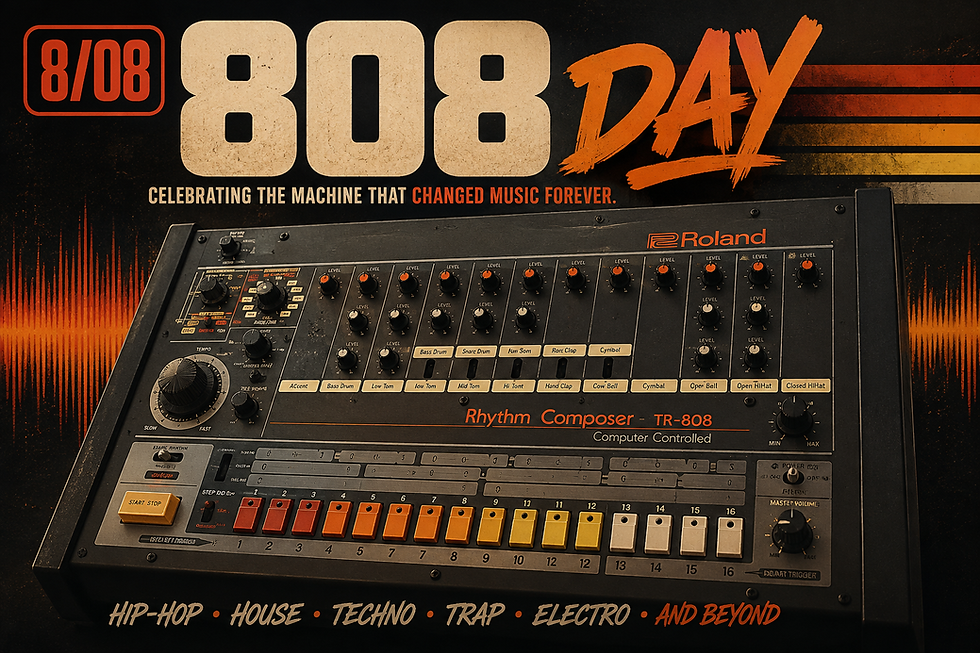
Every year on August 8, musicians, producers, DJs, and music fans celebrate one of the most influential pieces of music technology ever created: the Roland TR-808 Rhythm Composer.
August 8 becomes 8/08, making it the perfect date to celebrate the machine better known simply as the 808.
The funny thing is, the TR-808 wasn't initially considered revolutionary. Released in 1980, the drum machine struggled commercially and was discontinued only a few years later. But the strange, synthetic sounds that made the 808 less appealing to some musicians eventually became exactly what another generation of artists loved about it.
More than four decades later, the 808 has traveled from an actual piece of analog hardware to a musical vocabulary of its own. Hip-hop, electro, house, techno, R&B, pop and trap have all been shaped by its unmistakable sound.
So, for 808 Day 2026, let's rewind the beat and look at how one commercially unsuccessful drum machine ended up changing modern music.
What Is 808 Day?
808 Day is celebrated every August 8, or 8/08, in honor of the Roland TR-808 Rhythm Composer.
Roland released the TR-808 in 1980 as a programmable drum machine that allowed musicians to create and sequence their own rhythms. Instead of playing recordings of real drums, the TR-808 generated its percussion sounds using analog synthesis.
That distinction became incredibly important.
The kick didn't quite sound like a real bass drum. The cowbell certainly wasn't fooling anybody into thinking there was a cowbell player in the studio. The snare, handclap, hi-hats, claves and other sounds all had their own distinctly electronic personalities.
But eventually, musicians stopped caring about whether the TR-808 sounded like a drummer.
They cared about whether it sounded good.
808 Day celebrates not only the machine itself, but the enormous musical culture that developed around those sounds.
What Is the Roland TR-808 Rhythm Composer?
The Roland TR-808 Rhythm Composer is an analog programmable drum machine introduced by Roland Corporation in 1980.
The TR in its name stands for Transistor Rhythm, and the machine allowed musicians to program rhythmic patterns using sounds including bass drum, snare, toms, cymbal, hi-hats, handclap, claves, maracas and its now-famous cowbell.
But the superstar of the TR-808 became its bass drum.
The 808 kick produced a deep, booming low-frequency sound with a long decay. Instead of simply providing the attack of a traditional kick drum, it could occupy the lower end of a record in a completely different way.
Producers eventually discovered that the sound could be manipulated, tuned and extended until the kick effectively became part of the bassline itself.
That discovery helped transform the 808 from a rhythm machine into something much bigger.
Why Was the 808 Discontinued?
The Roland TR-808 was discontinued in 1983 after only a few years of production.
Part of the problem was timing.
In the early 1980s, many musicians wanted drum machines capable of producing increasingly realistic drum sounds. The TR-808 did almost the opposite. Its analog circuits created deliberately electronic-sounding percussion at a time when competing technology was moving toward sampled acoustic drums.
The machine wasn't a major commercial success, and only around 12,000 units were reportedly manufactured.
But its discontinuation helped create the conditions for its second life.
Used TR-808s began appearing on the secondhand market at prices that made them accessible to musicians and emerging producers who couldn't necessarily afford the newest studio equipment.
Those artists weren't interested in making the 808 imitate an acoustic drummer.
They wanted to know what else it could do.
And that question changed music.
Why Is the 808 So Popular?
The 808 became popular precisely because it didn't sound like a traditional drum kit.
Its booming bass drum could shake speakers. Its handclaps snapped. Its hi-hats ticked mechanically through a rhythm. Its metallic cowbell became instantly recognizable.
The imperfections became the personality.
Artists could also program rhythms without needing a live drummer or an expensive recording studio. For emerging electronic musicians and hip-hop producers, that opened enormous creative possibilities.
Early records helped demonstrate just how radically the machine could be used. Afrika Bambaataa & the Soulsonic Force's "Planet Rock" became one of the defining early examples of the TR-808 in hip-hop and electro, while Marvin Gaye's "Sexual Healing" brought its distinctive percussion into a major R&B hit.
From there, the machine spread.

The 808 became deeply connected to hip-hop and electro before finding new lives in house, techno, dance music, R&B and pop. Producers in different cities and countries didn't simply copy one another's use of the machine. They manipulated it into entirely different musical languages.
Chicago house found its own relationship with electronic rhythm. Detroit techno pushed machine-driven music into new territory. Hip-hop producers transformed booming kicks and programmed percussion into the foundations of new regional sounds.
Decades later, trap would once again reinvent the 808, turning long, tuned bass notes, slides and distorted low frequencies into one of the genre's defining characteristics.
Affiliate Disclosure: I may earn a commission from qualifying purchases.
What Does "808" Mean in Music Today?
Today, when someone says "808," they may not be talking about an actual Roland TR-808 at all.
The name has outgrown the hardware.
In modern hip-hop, trap and electronic production, "808" frequently refers to the deep bass or kick sound descended from the original TR-808 bass drum. Producers now use samples, software instruments, synthesizers and digital recreations to produce sounds inspired by the original machine.
An 808 can be tuned melodically, stretched, distorted, layered and manipulated in ways the designers of the original hardware probably never imagined.
That may be the clearest evidence of the TR-808's influence.
A product name became the name of a sound.
The sound became a production technique.
And the production technique became part of the vocabulary of modern music.
How Did the Roland TR-808 Change Hip-Hop, House, Techno and Trap?
The TR-808 arrived at exactly the right moment for musicians interested in creating sounds that didn't necessarily belong to traditional instruments.
Hip-hop embraced its enormous low end and programmable rhythms. Electro exploited its futuristic character. Chicago house producers incorporated electronic percussion into relentless dance grooves, while Detroit techno helped push drum machines and synthesizers toward an entirely new vision of electronic music.
Later generations kept rebuilding the machine's musical DNA.
Southern hip-hop made booming 808 bass an essential part of its sound. New Orleans bounce developed its own fiercely rhythmic relationship with drum-machine production. Trap producers eventually transformed the 808 kick into something simultaneously rhythmic, melodic and seismic.
And its influence extends well beyond those genres.
Elements of the 808 can be heard throughout contemporary R&B, dance music, EDM, experimental music and mainstream pop.
The original hardware disappeared from Roland's catalog decades ago.
Its sound never left.
How Is Roland Celebrating 808 Day 2026?
Roland is celebrating 808 Day 2026 with new programming examining both the history and future of its most famous rhythm machine.
This year, Roland has partnered with global radio platform NTS for "The Future Is Still 808," a three-part radio series hosted by artist and NTS resident Shy One and produced by documentarian Nick Dwyer.
The series traces the TR-808 from its origins in Japan through the musical communities that continually reinvented it, including the development of house in Chicago and techno in Detroit, as well as scenes throughout Asia, Europe, South America and beyond.
Episodes are scheduled to broadcast on August 8, August 11 and August 22.
The series also features a recurring "Happy Accidents" segment exploring the stories behind individual 808 sounds, including the famous bass drum and cowbell that became iconic partly because they didn't realistically imitate the instruments they were originally intended to reproduce.
The final episode brings the story into the present, examining what happened once musicians began sampling, chopping, pitching and transforming 808 sounds outside of the original machine.
Mannie Fresh Joins Roland's Rhythm Creators for 808 Day 2026
Roland is also bringing back its award-winning animated series The Rhythm Creators for 808 Day 2026.
This year's new installment features legendary New Orleans producer Mannie Fresh, whose production helped define the sound of Cash Money Records and brought his unmistakable approach to drum programming to records including Juvenile's "Back That Azz Up" and Big Tymers' "Get Your Roll On."
The series combines animation by Detroit artist Vaughn Taormina with stories narrated by the featured artists themselves.
Previous installments have featured artists including Egyptian Lover, Fatboy Slim, Prince Paul, Jazzie B, Orbital and KiNK, illustrating just how far the influence of one rhythm machine extends across genres and generations.
Can You Still Buy a Roland TR-808?
You can still buy an original Roland TR-808, but you're shopping for a highly collectible vintage instrument rather than an ordinary drum machine.
Fortunately, you don't need an original unit to make music with 808 sounds.
Roland has created several modern descendants and recreations of the TR-808, including the compact Roland TR-08, the performance-oriented TR-8S, and software recreations available through Roland Cloud.
There are also countless 808 sample packs, software instruments and third-party hardware machines inspired by the original.
For 808 Day 2026, Roland Cloud is offering its TR-808 Software Rhythm Composer for $49, reduced from its regular $149 price through August 31, 2026. The software recreates the original machine while adding features designed for modern DAW-based production. It's also included with a Roland Cloud Ultimate membership.
For musicians who want physical hardware without hunting down a vintage TR-808, modern machines such as Roland's TR-08 and TR-8S provide another route into the sound and workflow that started it all.
Why the Roland TR-808 Still Matters More Than 40 Years Later
Technology isn't supposed to work this way.
A piece of electronic equipment gets released, newer technology replaces it, and eventually it becomes obsolete.
The Roland TR-808 refused to follow that script.
Its original production run ended in 1983, yet musicians continued carrying its sounds forward. Every new generation found something else to do with them.
The 808 moved from hardware into samplers. From samplers into software. From a kick drum into a bass instrument. From the vocabulary of producers into the vocabulary of listeners.
People who have never touched a TR-808 know what an 808 is.
And more than four decades after Roland introduced a strange little rhythm machine whose drums didn't sound enough like real drums, producers are still trying to make those speakers shake with it.
That's why August 8 is 808 Day.
The machine may be vintage.
The beat isn't.
Check out the Roland Rhythm Composer, 10 Outputs (TR-08)

Affiliate Disclosure: I may earn a commission from qualifying purchases.


Comments